BUSINESS & PERFORMANCE HEALTH SCAN · PATIENT JOURNEY
The Patient Journey in the Aesthetic Clinic: From Awareness to Ambassador
A patient rarely selects an aesthetic clinic in a single step. This framework details the six operational phases, the corresponding metrics and the decisions you can take at each stage.
In this article
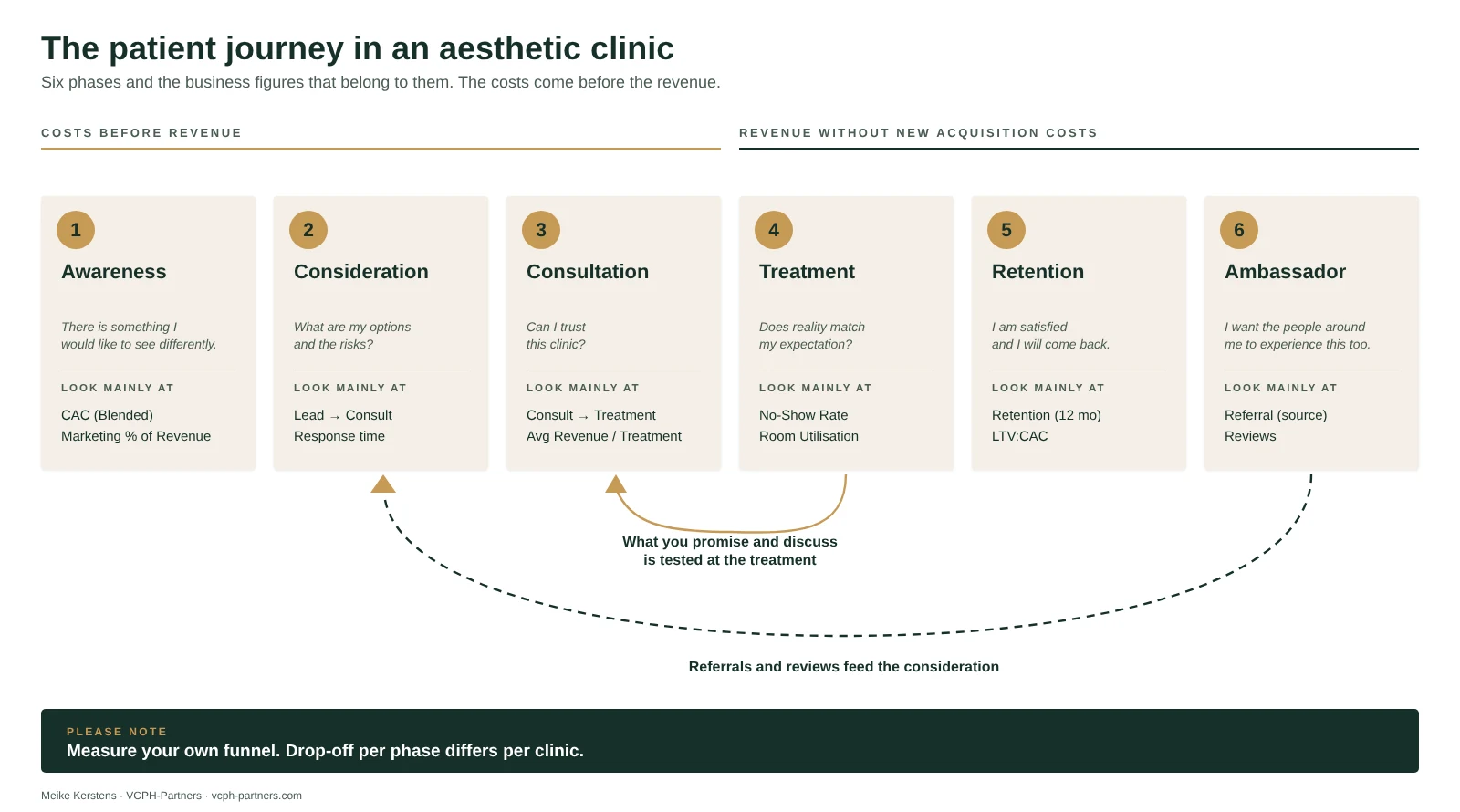
Every clinic owner wants prospective patients to move smoothly towards treatment and, in the long run, to become ambassadors for the clinic. A patient rarely makes that choice in one step. The process runs through six consecutive phases.
At every phase, prospective patients can drop out unnoticed. The first three phases require an upfront investment of time, money and team capacity. Direct revenue only starts at the treatment (phase 4).
The 6 phases of the patient journey in brief
1. Awareness
2. Consideration
3. Consultation
4. Treatment
5. Retention
6. Ambassador
Actionable decisions for your clinic
When deciding how to improve your patient journey, it helps to know how certain each connection is. We use three labels: arithmetical, behavioural, or a hypothesis you first test against your own data. Below, one decision per phase with advantages and points to watch.
- Arithmetical
- Follows directly from the definition of the number and always holds. Example: revenue from consultations = number of consultations × conversion × average value per treatment.
- Behavioural
- A recurring pattern that depends on your clinic’s execution, your team and your patient group. You need to see it in your own numbers.
- Hypothesis
- An assumption you must test on a small scale against your own data before investing money or time in it.
Phase 1: Awareness
Strategic decisionChoose a defined demographic positioningAim your marketing and education deliberately at specific patient profiles instead of broadcasting a broad, generic message.
Advantages
- A clearer profile. Patients know better whether you are right for them and the practice matches better what you promised.
Points to watch
- Less reach and fewer enquiries per euro spent.
Phase 2: Consideration
Strategic decisionProvide transparent price indicationsPublish clear price ranges on your website or in the first contact, to qualify enquiries early.
Advantages
- Less uncertainty up front. Enquirers know straight away where they stand.
Points to watch
- A price on its own can deter without context, while a tailored plan may turn out differently.
Phase 3: Consultation
Strategic decisionDiagnose before you proposeStart every consultation with a thorough inventory of the patient’s concerns before recommending a treatment.
Advantages
- The proposal fits the patient’s wish and reduces the chance of disappointment afterwards.
Points to watch
- Takes more time per consultation and requires communication skills from the practitioner.
Phase 4: Treatment
Strategic decisionBuild in structured follow-up reviewsSchedule a fixed check-in during or immediately after the treatment to review the outcome.
Advantages
- You see whether the expectation has been met, and it gives a natural moment to discuss the next step.
Points to watch
- Takes schedule space that could also be used for new treatments.
Phase 5: Retention
Strategic decisionAutomate recall and maintenance remindersSend an automatic message after a fixed period, or book the follow-up appointment straight away, linked to the expected longevity of each treatment.
Advantages
- Prevents patients from forgetting to come back and costs the team little structural time.
Points to watch
- Requires your patient data and scheduling system to be in order.
Phase 6: Ambassador
Strategic decisionTime your review requests wellAsk for a review or testimonial shortly after a successful follow-up appointment, when satisfaction is highest.
Advantages
- The experience is still fresh and positive reviews build trust.
Points to watch
- Asking too directly or pushily backfires. Take the rules of the platform into account.
Where to begin tracking data
To avoid data fatigue, start with a streamlined baseline before adding complexity.
1. Track three figures every month Enquiries, completed consultations and first-time treatments.
2. Add cohort retention Measure the percentage of new patients who return for a second treatment within twelve months.
This article is written from a business perspective. For medical protocols or legal and tax arrangements, consult the relevant specialists.
PATIENT JOURNEY
Identify where patients drop out in your clinic
In a conversation I place the connections from this article next to the numbers and experiences of your own clinic. We discuss what that means for your next step: growing, professionalising or preparing for a handover.
Schedule a strategic intro call Explore the Business & Performance Health Scan →
On this theme
Read also
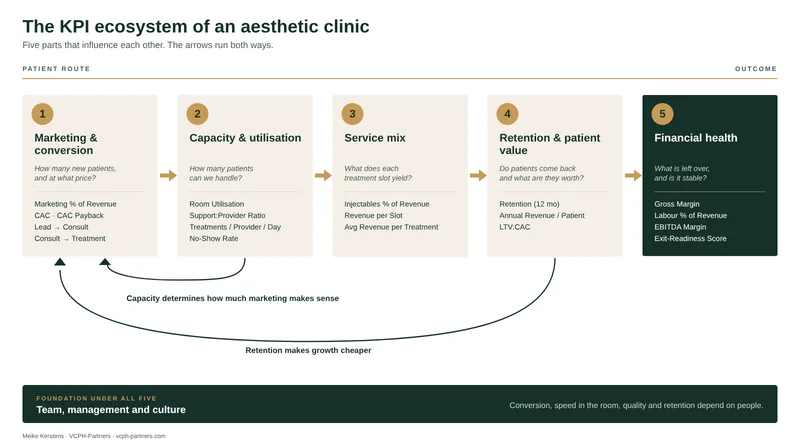
The Aesthetic Clinic as an Ecosystem
Why isolated KPIs obstruct effective governance: the five pillars of your monthly report, their interdependencies, and the true price of every decision.
Read article →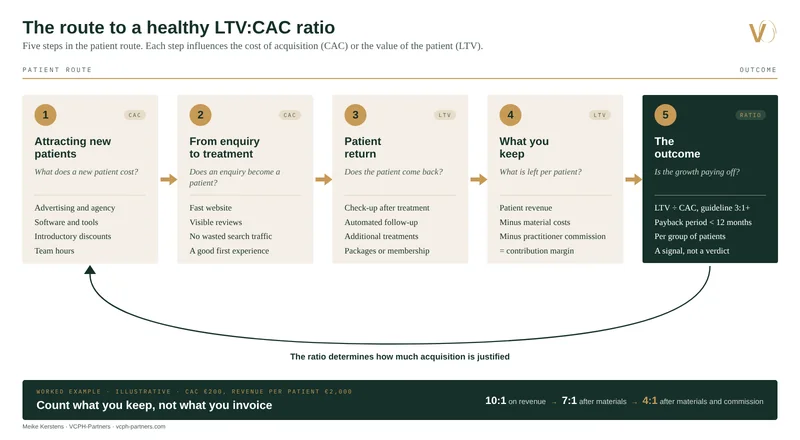
Acquisition Costs vs. Lifetime Value: Understanding Patient ROI
The LTV:CAC ratio explained using a practical worked example, five distinct clinic business models, and answers to frequently asked questions.
Read article →