BUSINESS & PERFORMANCE HEALTH SCAN · NEW DOCTORS
Everyone Wants the Doctor with the Longest Waiting List
But how do you fill the schedule of a new doctor when patients automatically reach for the established name? This article covers five choices, with the advantages and points to watch for each.
In this article
An empty schedule is not a matter of quality
A clinic hires a new doctor. The treatment room is ready, the doctor is qualified, the schedule is empty. Meanwhile patients automatically reach for the established name, because in medical aesthetics people choose on trust.
That is a structural problem and not a judgement on the doctor. The proof is still missing: reviews, results, reputation. The good news is that you can build that proof, and that you do not have to wait for the first patients to come by themselves.
In this article you read how trust works, which five choices reduce the disadvantage and what each choice delivers and demands.
The new doctor starts with a disadvantage
Trust is a system, not a feeling
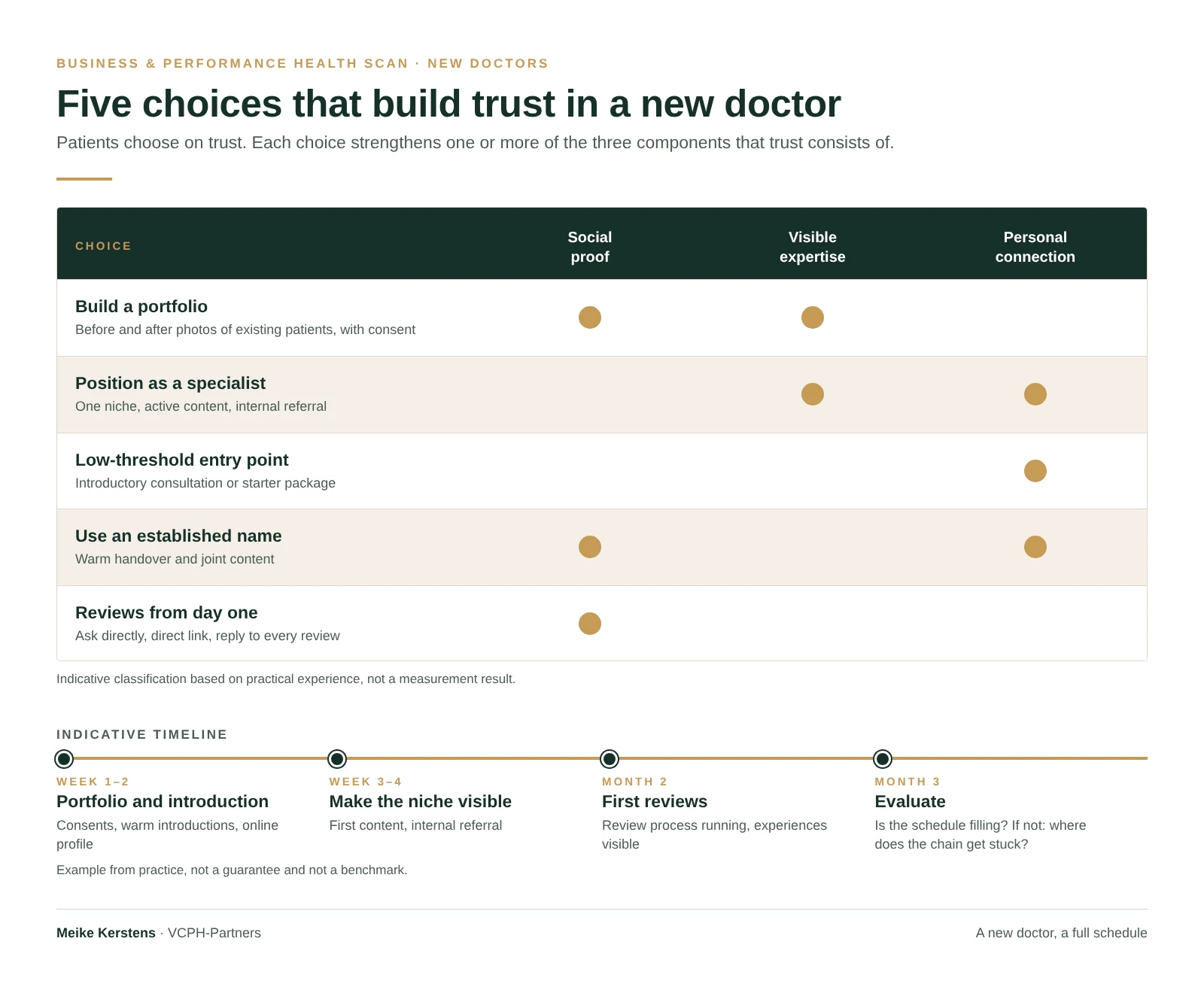
Patients look for proof: reviews, results, reputation. A new doctor has not yet built that proof, no matter how good that doctor is. That is a structural threshold, and you can lower it step by step. Three elements determine trust.
Social proof
Patients rely on the experiences of others. Without reviews and references the patient chooses the safe option: the known name.
Visible expertise
Training, certifications and specialisations do not speak for themselves. They have to be communicated actively.
Personal connection
The relationship starts before the treatment. How approachable does the doctor feel, online and in the practice?
Below are five choices that build this proof faster. For each choice you will find the advantages and points to watch. These are general trade-offs from my experience with clinics, not measurement results. How heavily they weigh differs per clinic.
ChoiceBuild a portfolio with the clinic’s existing patientsA new doctor does not have to start from zero. Ask existing patients for permission for before and after photos and have the clinic manager facilitate warm introductions.
Advantages
- Build proof without waiting for your own inflow.
- The portfolio shows results instead of promising them.
- The clinic manager can plan introductions.
Points to watch
- Requires explicit permission per patient and careful management of images.
- The patient must want to be treated by the new doctor.
- Costs time of the doctor and clinic manager in the first weeks.
Look at: number of first consultations scheduled per week, number of portfolio cases with permission.
ChoicePosition the new doctor as a specialist, not as a stand-inChoose one treatment or target group in which the doctor excels, communicate actively about it and have fellow doctors refer internally.
Advantages
- A sharp profile attracts targeted patients.
- Fellow doctors are the most credible ambassadors.
- Sharing knowledge via Instagram, newsletter and website builds visible expertise.
Points to watch
- A narrow niche limits the first inflow.
- Internal referral only works if colleagues also benefit from it.
- Requires content from the doctor personally, in text and preferably in video.
Look at: enquiries per treatment type, share of bookings via internal referral.
ChoiceOffer a low-threshold entry momentA free introductory consultation or an introductory package. As an invitation to get to know the doctor, not as a discount on quality.
Advantages
- Lowers the hesitation about a new doctor.
- The first appointment is the hardest. After that the experience speaks for itself.
Points to watch
- Costs schedule time without direct revenue.
- Can lower the value of the advice if it is seen as a discount (assumption: test it).
- Also attracts patients who do not go on to book.
Look at: Consult ➔ Treatment, No-Show Rate, Revenue per Slot.
ChoiceUse the power of the established name strategicallyThe lead doctor personally introduces the new colleague to suitable patients and they create content together, for example a case study or treatment video.
Advantages
- A recommendation from a trusted doctor weighs more than an advertisement.
- The reputation of the established doctor rubs off on the new name.
Points to watch
- Costs time of the busiest doctor in the clinic.
- Not every patient suits the new doctor. A poor match harms both.
- Makes the new doctor temporarily dependent on the established name.
Look at: Lead ➔ Consult after an introduction, available time of the lead doctor.
ChoiceCollect reviews from day oneAsk for feedback right after the appointment, by email or WhatsApp, with a direct link to Google or Trustpilot. Respond to every review.
Advantages
- Builds social proof, the first thing a new doctor lacks.
- A direct link makes responding easy. Every extra step costs responses.
- Responding shows commitment to patients who view the page.
Points to watch
- Requires a fixed process and someone who oversees it.
- A critical review is also visible online. How you respond then counts heavily.
- Some patients find a request right after the treatment pushy.
Look at: number of reviews per doctor per month, share of patients who receive a request.
How long does it take?
You do not build the waiting list in a week. With a fixed process and good collaboration between doctor and clinic manager, the transition from an empty to a full schedule can be a matter of months instead of years. The first patients are the key, because they build the rest.
AssumptionThe timeline below is an indicative example from my experience, not a guarantee and not a benchmark. How quickly it goes depends on the doctor, the type of treatment, your existing patient base and the local market.
- WEEK 1–2Portfolio and introductionAsk for permissions, the first warm introductions by the lead doctor, put the doctor’s profile online.
- WEEK 3–4Make the niche visibleFirst content about the chosen treatment, get internal referral going.
- MONTH 2Bring in the first reviewsThe review process is running and the first experiences are visible.
- MONTH 3EvaluateSee whether the schedule is filling. If not, determine at which step of the chain it pinches.
What the report does not show: the collaboration
For almost every choice above, two people need each other: the new doctor and the clinic manager, often with the lead doctor as a third. The introduction, the content, the review process and the introductory consultation do not come about without agreements on who does what and when.
AssumptionIn practice, a new doctor with an empty schedule is not only about visibility. It is also often about unclear agreements on who introduces the doctor, how much schedule room is reserved for introductions and who oversees the review process. That is why, in the Business & Performance Health Scan, I look at management and culture as well as business figures.
Five questions before the new doctor starts
Use these questions as a starting conversation with the doctor, the clinic manager and the lead doctor.
- 1What is this doctor’s niche?Which treatment or target group becomes the recognisable specialisation, and does the whole team know?
- 2Who introduces the doctor to which patients?Name the lead doctor or clinic manager, and agree how much time is set aside for it in the schedule.
- 3How do we build the portfolio?For whom do we ask permission, who manages the images and when is the first usable material ready?
- 4Which entry moment do we offer, and how do we prevent it from feeling like a discount?Limit the number of places and define how you measure the effect.
- 5How and when do we evaluate?Choose a number in advance, for example booked appointments per week, and a moment of evaluation. Decide what you do if the schedule does not fill.
Frequently asked questions
How long does it take before a new doctor’s schedule is full?
Isn’t a free introductory consultation just a discount?
May I use before and after photos of existing patients?
What if the new doctor prefers not to choose a niche?
What if the established doctor has no time for introductions?
Which numbers do I follow during the build-up?
Is this also relevant if I am starting a new practice myself?
Sources and accountability
- This article contains no figures from existing clinics. The strategies and trade-offs come from my practical experience. They are general trade-offs, not measurement results. How heavily they weigh differs per clinic.
- The timeline is an indicative example, not a benchmark.
- This article does not give tax, legal or compliance advice.
BUSINESS & PERFORMANCE HEALTH SCAN
A new doctor with a plan
In the Business & Performance Health Scan we look at the business performance of your clinic, at management and culture, and at what that means for your next step. Even if that step is a new doctor.
On this theme
Read also
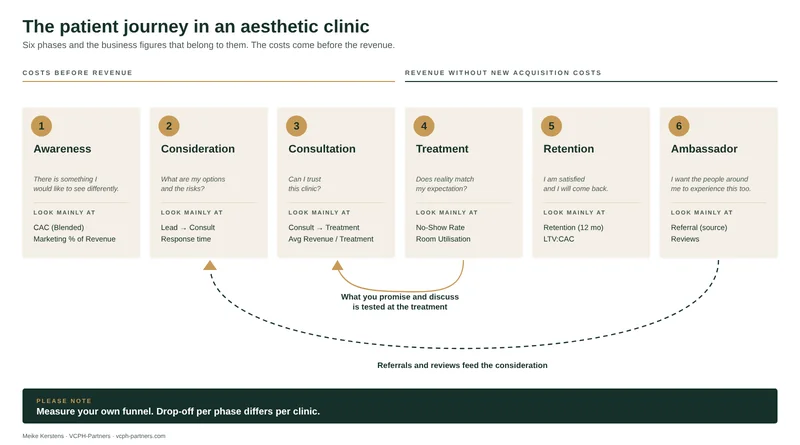
The Patient Journey in the Aesthetic Clinic: From Awareness to Ambassador
The six distinct phases of the patient journey: patient intent, corresponding financial and operational metrics, and actionable decisions for each stage.
Read article →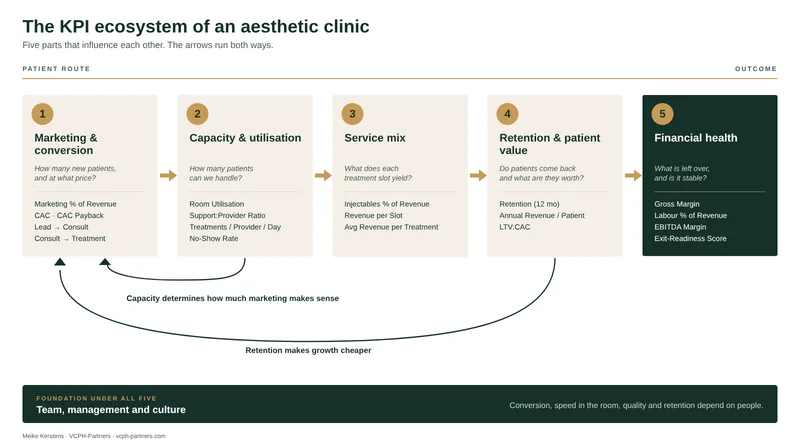
The Aesthetic Clinic as an Ecosystem
Why isolated KPIs obstruct effective governance: the five pillars of your monthly report, their interdependencies, and the true price of every decision.
Read article →