BUSINESS & PERFORMANCE HEALTH SCAN · GROWING PAINS
Growth Isn’t the Problem—Uncontrolled Growth Is
The pain points sit exactly where you do not expect them: in capacity and quality, in the brand and in the processes. This article shows what goes wrong and what you can do about it before it gets that far.
In this article
Growth in medical aesthetics sounds attractive. More treatment rooms, more doctors, perhaps a second location. Demand and margins are generally there. That is why the pain points rarely sit where you expect them.
They sit in the operational complexity that arises as soon as you start to scale. What happens by itself in a small clinic because everyone knows each other has to be put in writing as you grow. Clinics that do this early stay in control. Clinics that wait until it goes wrong repair afterwards.
In this article you walk through three growing pains, with the advantages and points to watch for each choice.
The pain is in the complexity, not in the demand
Growth in medical aesthetics sounds attractive. Demand and margins are generally there. The pain is in the operational complexity that arises as soon as you start to scale. In my work I see three points come back.
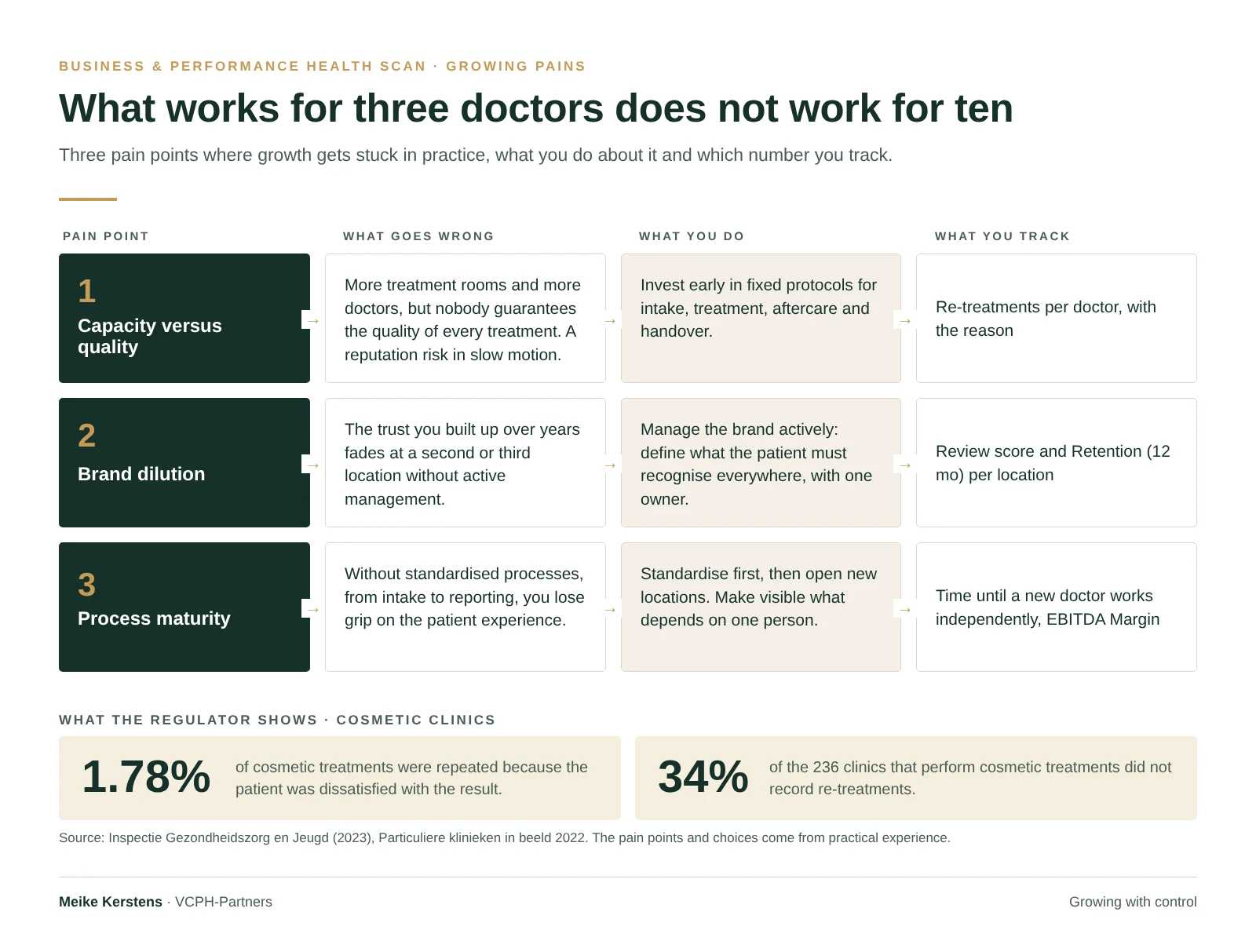
- 1. Capacity versus quality
- More treatment rooms and more doctors, but who safeguards the quality of every treatment? Growth without quality protocols is a reputation risk in slow motion.
- 2. Brand dilution
- A clinic builds trust for years. With a second or third location, that brand thins out if you do not manage it actively. This is a pattern from my practice, not a measured fact.
- 3. Process maturity
- What works for three doctors does not work for ten. Scaling requires standardised processes, from intake to aftercare and from planning to reporting. Without those processes you lose grip on the patient’s experience.
What the regulator shows
The report Particuliere klinieken in beeld 2022 (Private clinics under review 2022) by the Dutch Health and Youth Care Inspectorate (IGJ) gives a picture of quality assurance at cosmetic clinics. Two figures are relevant for this topic:
- On average, 1.78% of cosmetic treatments were repeated because the patient was dissatisfied with the result.
- Of the 236 clinics that perform cosmetic treatments, 34% did not record those re-treatments.
This says nothing about your clinic. It does show that part of the sector does not measure quality. Whoever does not record cannot see whether growth puts quality under pressure.
Decisions and their price
ChoiceInvest early in fixed protocolsPut intake, treatment standards, aftercare and handover between doctors in writing before the group gets bigger.
Advantages
- The same quality and explanation, regardless of which doctor the patient sees.
- New doctors can be deployed faster.
- You can see and discuss differences between doctors.
Points to watch
- Costs time and money at a moment when revenue does not yet rise because of it.
- Experienced doctors may see protocols as a restriction.
- Protocols that nobody maintains quickly become outdated.
Look at: re-treatments per doctor, reason for re-treatment, satisfaction after treatment.
ChoiceActively manage the brand at a second locationDefine what the patient must recognise at every location, and who is responsible for it.
Advantages
- The trust you have built goes with you to the new location.
- A recognisable experience makes the clinic easier to hand over or sell.
Points to watch
- Less room for local character per location.
- Requires an owner of the brand, not a side job for the clinic manager.
- A patient often chooses a doctor, so the brand alone is no guarantee of bookings (assumption).
Look at: review score per location, Retention (12 mo) per location, Lead ➔ Consult per location.
ChoiceFirst standardise, then open new locationsDetermine the order: only expand when the existing processes demonstrably work.
Advantages
- Grow on a foundation you can explain to an investor or buyer.
- Less chance that a second location weakens the first.
Points to watch
- Competitors who open faster can win market share.
- It can demotivate if the team wants to see growth.
- There is no fixed rule for when the processes are mature enough.
Look at: how much of the work depends on one person, time until a new doctor works independently, EBITDA Margin.
What the report does not show: the team
Protocols, brand agreements and processes only work if the team carries them. A standard that exists on paper but is not followed in practice gives false certainty.
AssumptionA clinic where agreements live in the heads of the founders often grows faster than the organisation can keep up with. You see that later in varying quality and varying conversion, but the cause is not in the numbers. That is why, in the Business & Performance Health Scan, I look at management and culture as well as business figures.
Five questions before you add a doctor or location
Use these questions for every growth decision, big or small.
- 1Why are we growing now, and which number should improve because of it?Without a concrete goal you cannot assess the effect.
- 2What is documented and what lives in heads?Intake, treatment standards and aftercare. What now only sits with the founder does not scale.
- 3How do we measure whether quality stays the same?Record re-treatments per doctor, with the reason, before you expand.
- 4Who owns the brand at each location?Appoint someone responsible and define what the patient must recognise everywhere.
- 5When do we evaluate and what do we do if it does not work?Define in advance which number you follow and after how many months you adjust the choice.
Frequently asked questions
From how many doctors do I need protocols?
How do I keep my brand intact at a second location?
How do I know whether I am growing too fast?
Isn’t standardising early a brake on growth?
Which numbers do I follow during growth?
Does this help if I want to sell in a few years?
Is this also relevant for a clinic with one location?
Sources and accountability
- Inspectie Gezondheidszorg en Jeugd (2023), Particuliere klinieken in beeld 2022: 1.78% re-treatment due to dissatisfaction; 34% of 236 clinics did not record re-treatments.
- Otherwise this article contains no figures from existing clinics. The strategies and trade-offs come from my practical experience. They are general trade-offs, not measurement results. How heavily they weigh differs per clinic.
- This article does not give tax, legal or compliance advice.
IGJ source: Particuliere klinieken in beeld 2022 (pdf, in Dutch)
BUSINESS & PERFORMANCE HEALTH SCAN
Growing with control
In the Business & Performance Health Scan we look at the business performance of your clinic, at management and culture, and at what that means for your next step: a new doctor, a second location or preparing for a handover.
On this theme
Read also
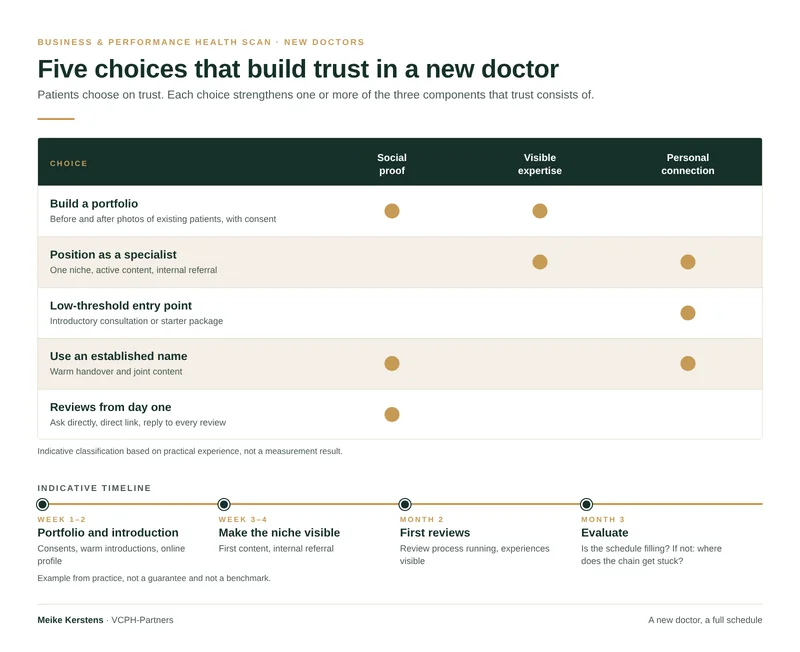
Everyone Wants the Doctor with the Longest Waiting List
How do you successfully build the schedule for a new practitioner? Five strategic choices to establish trust, complete with trade-offs, key considerations and an indicative timeline.
Read article →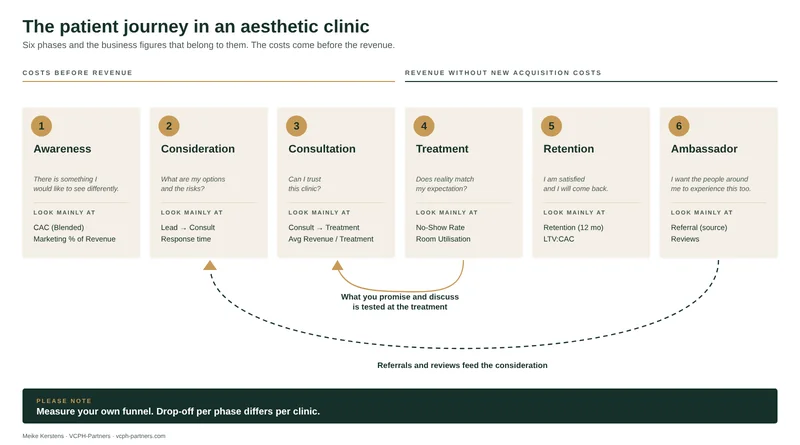
The Patient Journey in the Aesthetic Clinic: From Awareness to Ambassador
The six distinct phases of the patient journey: patient intent, corresponding financial and operational metrics, and actionable decisions for each stage.
Read article →